

Byline

Biofábrica de insetos se instala em hub de inovação do MA

Projeto conecta resíduos de cervejaria e frutas à produção de biomassa.

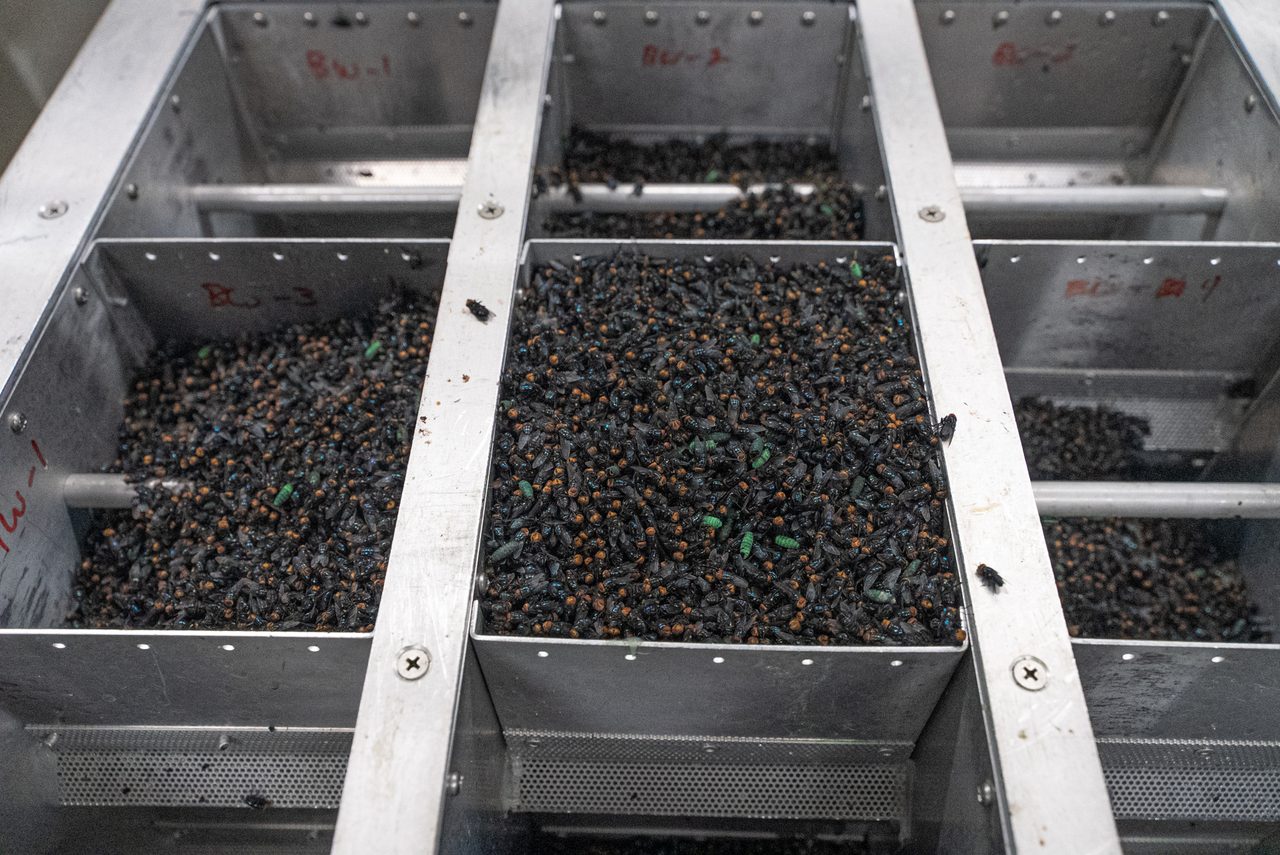
Larvas de insetos em recipientes metálicos para fins de pesquisa científica ou criação industrial.
Foto: U.S. Department of Agriculture
Legenda
Special aerial dispersal system fly containers are packed with approximately 2 million sterile New World Screwworm fly ready for transport to the South Texas International Airport in Edinburg, TX where they will be loaded and attached to the dispersal system that has a cooling system to keep the flies docile and an auger system to safely deliver a measured amount of flies from a twin turboprop aircraft over predetermined zones over Texas along the US/Mexico border on July 2, 2026. Once at the drop zone the aircraft followed GPS guided north–south or east–west grids at about 6,500 feet, allowing broad, even distribution over the target zone near the Mexico border. As the pilot nears the first drop zone, he will alert the Dispersing Technician to prepare for dispersal. On the pilot‘s cue, the technician activates the aircraft’s dispersal systems. A motorized auger system begins to slowly turn to maintain a controlled release rate while the autopilot flies the preprogrammed pattern. After completing each grid, crews land to refuel before returning to their base of operation. The sterile fly program, built on decades of multinational cooperation, uses continuous aerial release to halt the spread of New World Screwworm by overwhelming wild populations with sterile males. With multi agency coordination—from CBP inspections to USDA documentation, facility processing, Texas National Guard, and specialized aviation support—the operation demonstrates an intensive, international effort to protect livestock, wildlife, and communities across the region. Videos are at the Defense Visual Information Distribution System (DVIDS) <a href="https://www.dvidshub.net/feature/NewWorldScrewworm" rel="noreferrer nofollow">www.dvidshub.net/feature/NewWorldScrewworm</a> Photos are at DVIDS and the USDA APHIS Flickr Collection <a href="https://www.flickr.com/photos/usdagov/collections/72157625204032244/">www.flickr.com/photos/usdagov/collections/72157625204032244/</a> USDA Media by Lance Cheung. Attribution appreciated.

Uma nova fábrica de criação e processamento de insetos instalou-se no Hub SENAI de Inovação e Tecnologia em São Luís. A biofábrica estrutura a produção no modelo de biorrefinaria de insetos.

Nesse sistema, os resíduos orgânicos de cervejarias e frutas são usados para alimentar os insetos. O processo aproveita a biomassa em diferentes etapas, conectando cadeias produtivas.

A empresa também comercializa tenébrios vivos, que são a base do processo. Os animais vivos são um produto do sistema. A empresa já identificou afinidade com três iniciativas do ecossistema.

As empresas Cervejaria Dona, Acerolima e Sabor da Ilha são potenciais parceiras no fornecimento de resíduos. Segundo o gestor do projeto, Cláudio Urbano, essas são as primeiras sinergias mapeadas.

Voltar para Economia