

Byline
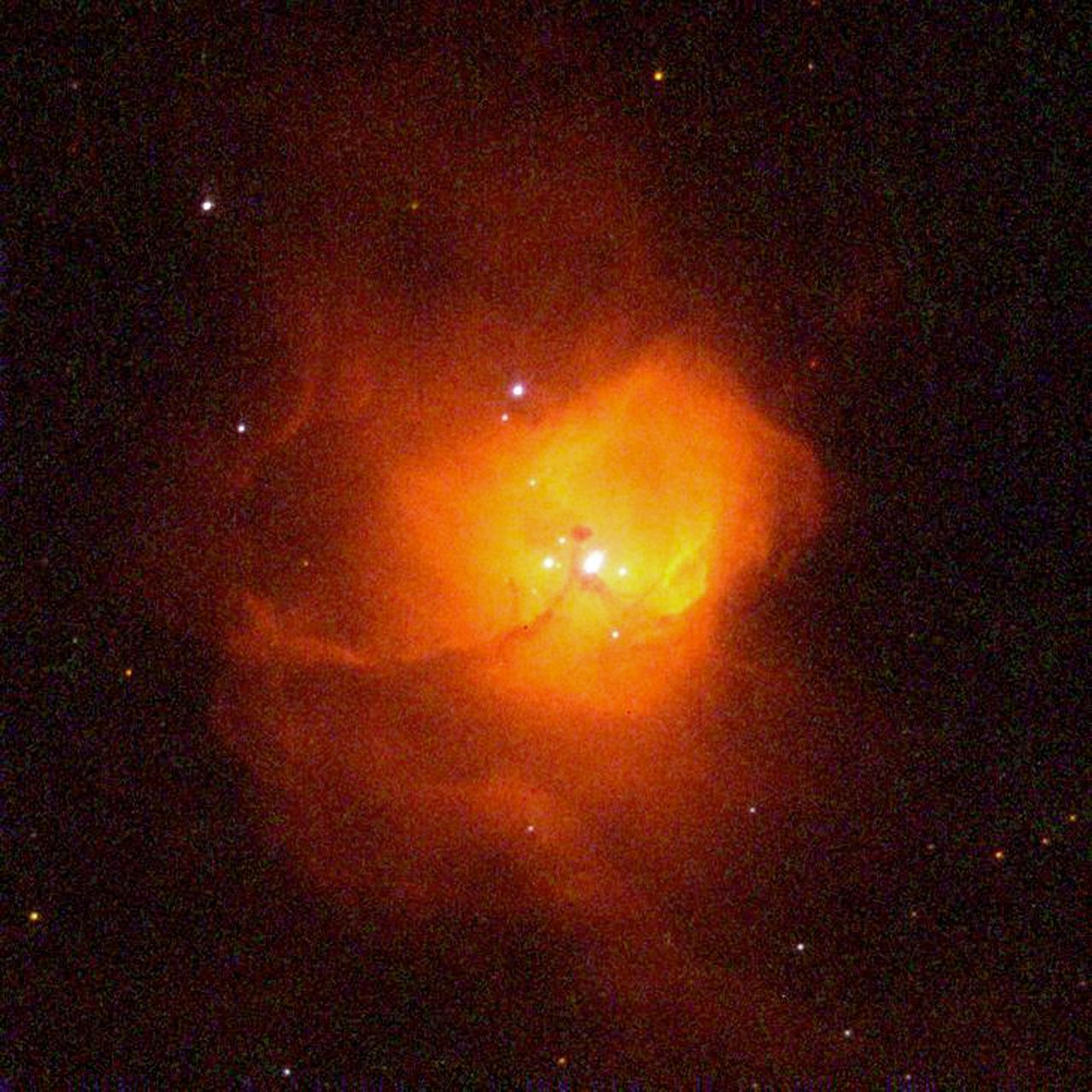
Uma nebulosa em tons de laranja e amarelo com pontos brilhantes de estrelas ao centro, contrastando com o fundo escuro do espaço sideral.
Foto: NASA on The Commons
Legenda
A NASA Hubble Space Telescope "family portrait" of young, ultra-bright stars nested in their embryonic cloud of glowing gases. The celestial maternity ward, called N81, is located 200,000 light-years away in the Small Magellanic Cloud (SMC), a small irregular satellite galaxy of our Milky Way. Hubble's exquisite resolution allows astronomers to pinpoint 50 separate stars tightly packed in the nebula's core within a 10 light- year diameter - slightly more than twice the distance between earth and the nearest star to our sun. The closest pair of stars is only 1/3 of a light-year apart (0.3 arcseconds in the sky). This furious rate of mass loss from these super-hot stars is evident in the Hubble picture that reveals dramatic shapes sculpted in the nebula's wall of glowing gases by violent stellar winds and shock waves. A pair of bright stars in the center of the nebula is pouring out most of the ultraviolet radiation to make the nebula glow. Just above them, a small dark knot is all that is left of the cold cloud of molecular hydrogen and dust the stars were born from. Dark absorption lanes of residual dust trisect the nebula. The nebula offers a unique opportunity for a close-up glimpse at the firestorm' accompanying the birth of extremely massive stars, each blazing with the brilliance of 300,000 of our suns. Such galactic fireworks were much more common billions of years ago in the early universe, when most star formation took place. The "natural- color" view was assembled from separate images taken with the Wide Field and Planetary Camera 2, in ultraviolet light and two narrow emission lines of ionized Hydrogen (H-alpha, H-beta).

O buraco negro RBH-1 viaja a 954 km/s, mostra pesquisa

Objeto dez milhões de vezes maior que o Sol deixa cauda de estrelas de 200 mil anos-luz

O buraco negro supermassivo identificado como RBH-1 desloca-se a 954 quilômetros por segundo, de acordo com estudo do Instituto Kavli de Física Teórica. O objeto é dez milhões de vezes mais massivo que o Sol.

Uma cauda de estrelas com 200 mil anos-luz de extensão marca o rastro da imensa estrutura pelo cosmos. A constatação da existência do RBH-1 ocorreu de forma autônoma ao telescópio Hubble, em dezembro de 2025, por meio do telescópio James Webb.

Segundo os pesquisadores, o buraco negro constitui a evidência mais clara de um objeto desse tipo arrancado do núcleo de sua galáxia. O fenômeno muito provavelmente foi causado pelo recuo de ondas gravitacionais, afirmou o autor do estudo.

A primeira observação do RBH-1 aconteceu em 2023. Cientistas questionam-se sobre como um corpo tão imenso poderia ter surgido e alcançado velocidade tão alta.

Em artigo publicado em agosto na Physical Review Letters, a equipe de cientistas do Instituto Kavli e das Universidades da Califórnia e do Texas detalhou a descoberta. Eles recriaram em simulações a colisão entre buracos negros que pode ter originado o caminho percorrido.

Segundo os modelos da pesquisa, um dos buracos negros fundidos era seis vezes mais massivo que o parceiro e tinha rotação muito veloz. A fusão teria gerado o impulso que agora propele o RBH-1.

Voltar para Tecnologia