

Byline

NASA quer elevar órbita do Hubble para evitar reentrada em 2033

Agência faz pedido à indústria e estuda reentrada controlada

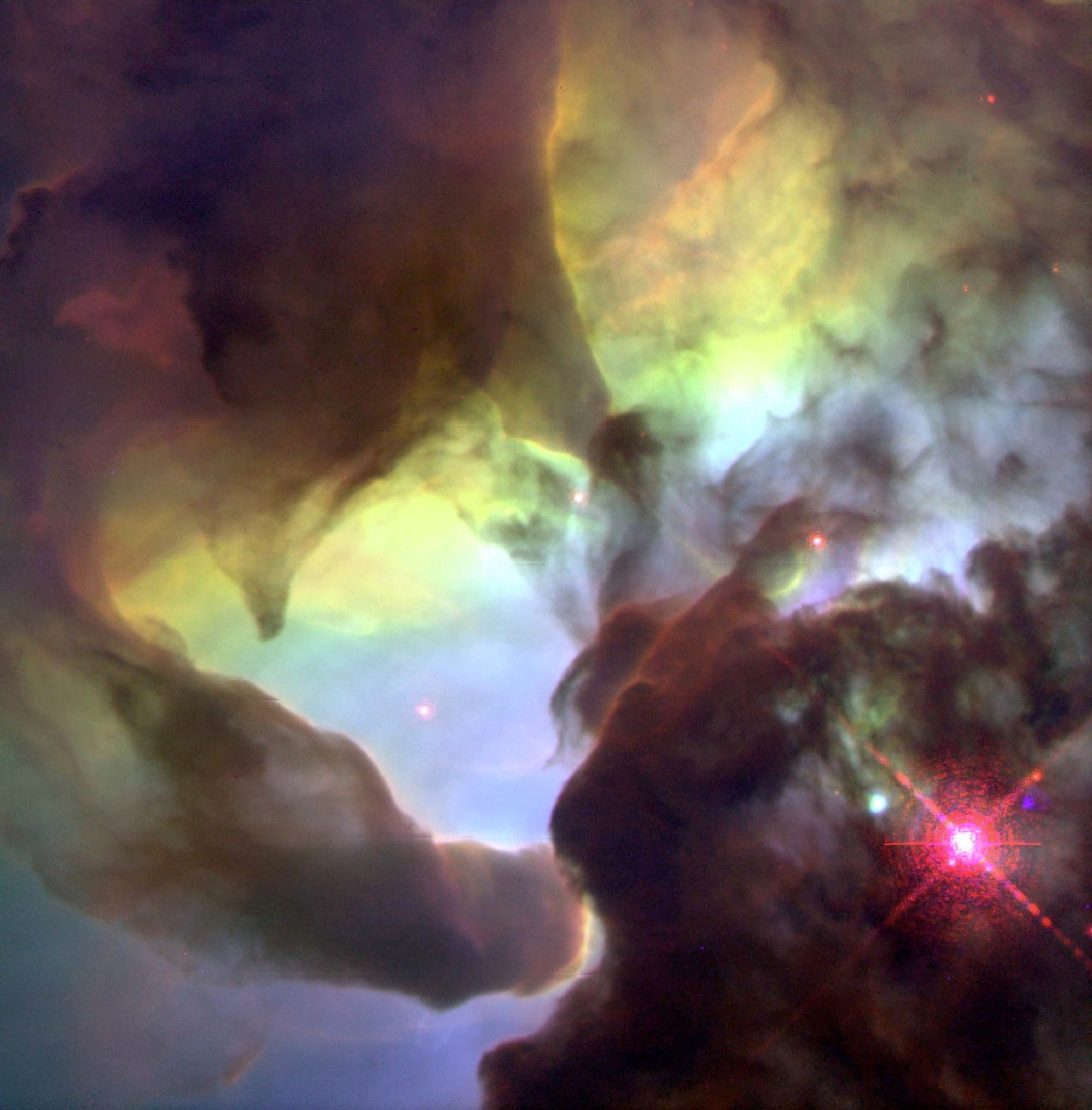
Nuvens de gás e poeira coloridas em tons de verde, amarelo e roxo formam uma nebulosa no espaço com estrelas brilhantes ao fundo.
Foto: NASA on The Commons
Legenda
This NASA Hubble Space Telescope (HST) image reveals a pair of one-half light-year long interstellar "twisters," eerie funnels and twisted-rope structures in the heart of the Lagoon Nebula (Messier 8) which lies 5,000 light-years away in the direction of the constellation Sagittarius. The central hot star, O Herschel 36 (lower right), is the primary source of the ionizing radiation for the brightest region in the nebula, called the Hourglass. Analogous to the spectacular phenomena of Earth tornadoes, the large difference in temperature between the hot surface and cold interior of the clouds, combined with the pressure of starlight, may produce strong horizontal shear to twist the clouds into their tornado-like appearance. Though the spiral shapes suggest the clouds are "twisting," future observations will be needed, perhaps with Hubble's next generation instruments, with the spectroscopic capabilities of the Space Telescope Imaging Spectrograph (STIS) or the Near Infrared Camera and Multi-Object Spectrometer (NICMOS), to actually measure velocities. These color-coded images are the combination of individual exposures taken in July and September, 1995 with Hubble's Wide Field and Planetary Camera 2 (WFPC2) through three narrow-band filters (red light ionized sulphur atoms, blue light, double ionized oxygen atoms, green light, ionized hydrogen).

A NASA emitiu solicitação formal para propostas da indústria privada para serviços de manutenção do telescópio Hubble.

A medida visa prolongar a vida útil do equipamento e avaliar opções para sua reentrada controlada.

Através de análise própria, a agência afirma que o Hubble deve reentrar na atmosfera terrestre por volta de 2033 ou 2034 se nada for feito.

A administradora associada da NASA, Nicky Fox, declarou que a agência quer usar o tempo até a reentrada prevista para estudar maneiras de elevar a órbita.

Segundo a NASA, uma missão para elevar a órbita do telescópio precisaria ocorrer até 2032.

A agência firmou um acordo sem financiamento com a SpaceX em setembro de 2022 para estudar a possibilidade de usar a espaçonave Dragon nessa tarefa.

Em junho de 2024, a NASA anunciou a transição do Hubble para um modo de operação com apenas um dos seis giroscópios devido a falhas.

Jared Isaacman, administrador da NASA, afirmou que a agência deve buscar maneiras inovadoras e de baixo custo para prolongar a vida científica do Hubble.

Voltar para Economia